Friday, September 14, 2012

Two new Gems

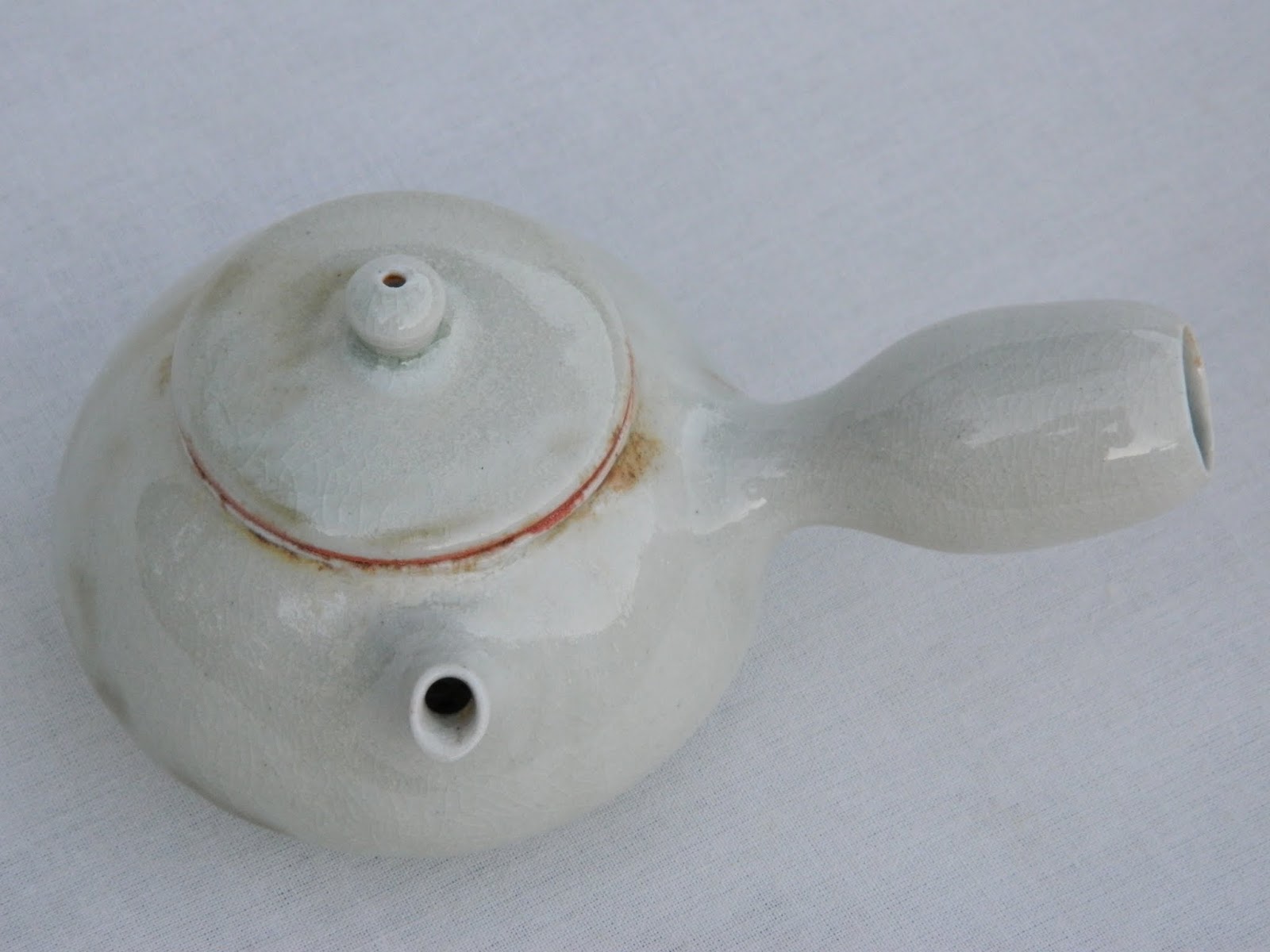
I am late! I am so late that I already have two new Gems to share. First was fired in July, second one then on the end of September. Both teapots have similar nature. Both are glazed in smooth, celadon crackle glaze. But recipes are different and what is more, I have used different clays. It gives you, my inquiring readers, opportunity to compare two siblings. Each has not only different look but also their energy is unique.

For more pictures of the set please visit this page. If this "Ten Gem of Ten Kilns" project is new for you, then read this post first.

Preparing this post, I get into predictable problem. I am not able to take pictures of such light and shiny pieces. At least I am not fully satisfied with any of those shots I made. So, please, use piece of your imagination to  get whole and real image.

Gem Number Six- Luminous 


Gem Number Seven- Quarry Under Jade Water


Thanks for the reading!


Monday, August 20, 2012

Patty-pan Squash Teapot

We held three ceramic workshops this summer. Rather busy time with many new people and new experiences in our house and studio. The last class was focused on making molds from products of nature as apples, pumpkins, cantaloupes...This class was the only one where an external instructor was needed. When it comes to plaster then we know just basics. Fortunately our friend Ola Hořavová has studied those techniques on ceramic high school and continued on university. She also uses molds and hendbuild techniques in her own ceramic work. She have shared her knowledge with our students for almost a week. All students worked hard (we made them to:)). Thanks to big enthusiasm of all participants we round off the week by firing of our small woodkiln. Clicking here, you are going to open picasa album with many pictures from the event.


 On pictures below you can see one of patty-pan teapots I have made during my demonstration on the workshop. Body of this teapot was shaped in plaster mold. I will probably not use this technique for my own, regular production (at least, not any time soon). Nevertheless, work on teapots this way was more then interesting experience. Teaching how to make teapot I have learn not just how to work with plaster. It also help me to keep my eyes open to shapes growing around us. It is always beneficial to see your own work from another perspective and this was the case. Big thanks to Ola, and to all creative people around us!

Here it sample fresh sheng from Youle...
The Patty-pan which was used for making mold of this teapot was eaten:) So those two are here just for their beauty.


Thanks for reading!

Monday, August 6, 2012

Butterfly from 1996


1996 Xia Guan Butterfly Spring Tou Sheng is packed in lovely paper, the name and the year of origin are promising...

 Before we will take a look inside, let's read vendor's words about it:

"This tea was made in 1996 for Taiwan market. According to the supplier, leaf maretial of this tea was from 300 years old arbor tea three. Although this connot be physically proved, it is very likely to be true, as indicated by the leaf quality. The tea has been in purely dry storage over the past 15 year and demonstrates features of high quality dry-aged sheng. The flavor is significantly different from that of shengs aged in humid storage. Current price of this tea is based on supplying cost. The price is subject adjustment in the future based on rarity" 

More you can find here, on Gingo's blog

On pictures bellow you can see naked leaves.
 As usually, it is not easy to take pictures of leaves. Especially if those pictures should be reflective of  real color of aging. I did my best, so maybe you can see the mixture of dark green, brown and hairy, grey leaves- all unified by passed years. Maybe, you can also see light. white dots (like small flowers) I consider the white flowers as those here to be crystallized essential oils.

 Pressing is, compare to other Xia Tou I have, lighter. It is still Xia Guan toucha and inside you will find more compressed, not-easy-to-separate, leaves. But taking leaves from side, I did not even have to use my puehr needle and I got leaves like that...


Smell of dry leaves is gentle, just light wood and ripe fruits. These are stronger on wet leaves. First infusion (ten second) already gives dark orange tea. As you can see on picture bellow, color is (as always) very relative...

First infusion is in both cup and faircup. Fair cup is just deeper.
Second infusion...


In first infusion I can find mixture of light pine nuts, oranges and some flowers. From second brew, the Xia Guan origin is already unconcealed. There is smoke, resin, orange-peel- all mellowed thanks to  sixteen years of aging.

 Focusing on taste and mouth feel during the fourth infusion I found spicy, hot, almost pepper like, effect on my lips and tongue. It was in contrast to cooling menthol-camhor sensation in my throat. I know that this is probably not attractive for everybody. It is like Islay Whisky- peat, iodine, pepper... Why should one drink something like this? Yet, there are many Islay fans as there are many fans of traditional Xia Guan products. And I do understand them...

Another opportunity to test another stove...


I have this tea at home for more then year now and I am still happy that I decided to buy it then. I can imagine that many of you would find it to be "too dry stored". I like it as representative example of good, half-aged, dry stored tea. And it is still for rather reasonable price. When I have purchased it, it was for less then 100usd/250g toucha. Now it is 135usd, which is not cheap tea. When we talk about 16years old, rarity Xia Guan, then it is, al least, reasonable. Especially when one can go for sample first...

Why are you smilling? Is it the tea inside you or sun up in the sky? 
After my tea session I have felt calm and happy. I am not sure if it was tea itself, or also power of the fresh morning with birds flying around. Maybe all was just right.


Thank you for reading!

Monday, July 16, 2012

Puerh Storage Jars


Storage of Puerh - what a topic, right? If there would be a statistic, which define most discussed topic betwen tea people, the storage of puerh surely is going to be on the top. So what can I, still bigginer here, add? Not much, just a few thoughts and experiences... Nevertheless, I look forward to hear any thoughts and practices of my readers - thoughts and experiences about what I am going to present here as well as about storage generally.
I made my first "cake jars" in autumn 2009. Those two jars were originally made for my customer, but I have used unsuitable clay and cracks on bottoms, which have shown after firing, made those jars unsellable. Thanks to this, I can see now, after two and half years, how cakes are doing in those jars... so far, they smell and taste great. I store there cakes from first LongFeng production (spring teas from 2009). No jar will make a magic here. My too dry and cold storage conditions are successful decelerators of aging. But jars protect tea from dust and smells. And more importantly, they helps to create microclime as well as reduce drying out essential oils from leaves. On the picture below you can see color of Purple Lable (leaves shoudl be from old threes from Ai Lao)
Leaves are darker and whole profile sligltly "ripen"...


As time went on, more and more tea loves asked me to make storege jars for them. And also my stock ( I do not fell like collector yet:)) has been growing. I started make bigger jars, basicaly in two sizes. For 400-500g cakes and for 200-250g ones. Into one bigger jar you can put 10-11 cakes. It means between 4-5kg of tea.

This information can give a notion about to what kind of puerh drinker is it for. When one starts, having cake or two, sampling around, then just love for ceramic can make him think about buying such piece. On the other hand, if you buy cakes mostly in tongs, continuously for years, then you can welcome it as a sample box. Yes, there are puehr fans who build their houses from tea or, at least, fill their flats to roof... but I believe that most of us just buy cake here, brick  there. And despite of fact that we know that we are not living in the best areas for aging tea, we can not help ourselves and we buy more then we drink right now. That is why I find those jars convenient for me. My mixture of different cakes, touchas and bricks looks much more happy in several ceramic jars then laying in shelves.

but there are shapes and sizes which are not easy to fit...
I was never in fever to buy and stock a lot of  young tea in order to safe money and get some great aged tea after 20-30 years. I always prefer to pick variety of teas in sense of years, styles, areas...And ENJOY IT NOW! I have learn to buy teas for what they are now, not for future, dreamy brew.


Dry vs Wet

I have (or had) very pleasant dry stored teas as well as wet, or traditional stored teas. I am not afraid of moisture (I can recomment to read and think about "sharp" Marshal's post here). But I am not afraid of dry or natural storage either. Recently I have two - three samples from around 2000 and I would love to have cake or two from each of them. All were obviously dry stored - green leaves, smell and color of first breaves say that. One of them was stored in Taiwan, one in Kunming. Complexity of the taste make me wonder - would it be any better in HK? Or here in Czech Rep.? I dont know, but I know that there are many wet and, many dry teas worth to try. I have to say that I start to like teas, which went thru some wet period. Unfortunately it is almost impossible to find good, traditional (wet) stored tea, here in the middle of Europe. You can find many muddy like shus, from poor to great young shengs and some decent dry stored aged shengs. But I know just about one company selling rather good, traditional stored shengs here (declarations and prices are another story) Then there are some, from good to great, rather wet stored teas from EoT. Do you know any interesting source of traditional stored puehrs in Europe? Or some safe bets in Asia or US? Please share!
Tea taste better in rainy day... 

Many friends and customers ask about my experiences with long term storage. Is this jar the right choice for my premium cakes? What clay is the best for such puehr jar? For oolongs? What shape and what size? Well, I can just guess and use common sense. If you have any findings on this field feel free to jump in...


Thanks for reading!